
About the Book
The West stands at a crossroads. Decades of demographic decline, monetary distortion, industrial outsourcing, and geopolitical complacency have eroded the foundations that once made Western civilization the most innovative and prosperous force in human history.
Pax Occidentalis is a data-driven manifesto that maps the structural fractures, from collapsing birth rates to critical-mineral dependencies, and charts a concrete path toward renewal. It is not a lament for what was, but a blueprint for what could be.
The Argument
Every existential problem the West faces is a problem of scale, and the nation-state no longer has it. Demographic policy needs fiscal resources no single treasury commands; industrial sovereignty needs a market large enough to justify rebuilding entire supply chains; deterring continental superpowers needs continental scale. The unit of survival in this century is the civilizational bloc, and the West is the only major civilization not yet organized as one. The answer is a Western Federation of one billion citizens spanning North America, Europe, and Oceania.
In 1900, one human being in three was Western. Today it is one in seven; by century's end, one in ten. No Western country reaches the replacement rate of 2.1 children per woman: the EU averages 1.5, the United States 1.62, Italy and Spain near 1.2. At a rate of 1.5, one hundred grandparents produce fifty-six grandchildren: the native population halves in three generations while pension systems already absorb 10 to 12 percent of GDP. This is arithmetic already underway, masked only by longevity and immigration.
The West outsourced the physical foundations of its own civilization and called it efficiency. Europe is an industrial engine without fuel; North America holds resources but ceded the processing; Oceania is a mining superpower with its hands tied. Beijing secured the mines, monopolized the refineries, and converted rare earths, battery materials, pharmaceutical precursors, and chips into instruments of coercion. A civilization that cannot make its own semiconductors or synthesize its own antibiotics is not sovereign.
Domestically, concentrated money writes policy: the military-industrial complex, pharmaceutical and financial sectors, technology oligarchies that own the public square. Externally, foreign powers operate inside open societies with near impunity. The referee has been bought, and everyone playing knows it. Defeating capture requires a jurisdiction too wide for money to arbitrage, with anti-corruption rules written as constitutional hardware rather than discretionary regulation.
The constitutional bargain is a strict enumeration. The Federation receives only the powers that no longer function at national scale: defense, external trade, the common currency, competition enforcement, AI safety. Everything else stays national, and that is most of government: criminal law, education, healthcare, family law, welfare design. No nation is trapped: an explicit right of secession is written into the founding treaty. The Federation commands the fleet; the nation runs the school.
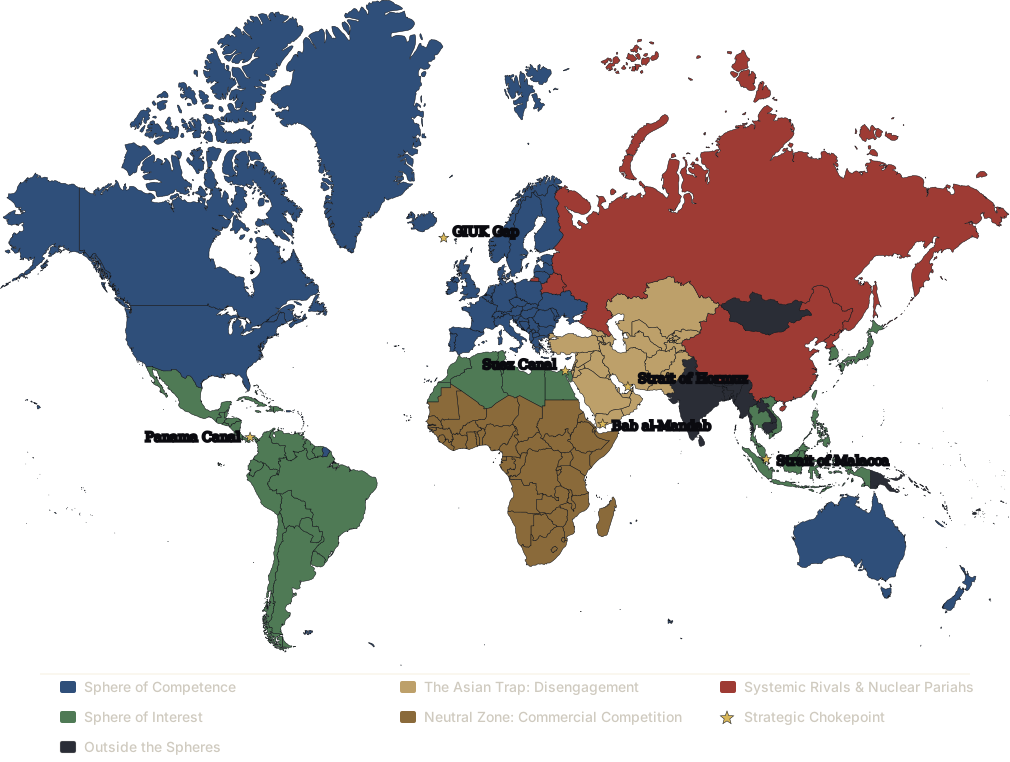
Foreign policy gets an operating system: a transparent hierarchy in which privileges scale with alignment. The First Ring is the Federation itself. The Second opens to Latin America through a Mutual Development Pact of defense guarantees and co-investment. The Third holds trusted partners like Japan and South Korea. The Fourth is everyone else, including systemic adversaries: access to the Western market only on Western terms, with settlement in the Federation's currency.
The fifty-year fiat experiment has reached its terminal phase. The cure is a constitutional separation of state and money: the Solidus, fiat in daily operation but anchored by gold and Bitcoin reserves worth no less than 20 percent of the entire money supply, making expansion inherently expensive. The central bank is a chained guardian with a single mandate, quantitative easing constitutionally prohibited, and every citizen holds a legal right to exit into gold, Bitcoin, or private monies.
The Catalyst State cannot create life, but it can prepare the soil. Income tax falls 30 percent with the first child, 55 with the second, 75 with the third. Employers receive contribution cuts that turn parenthood from a hidden liability into a tax benefit. The full cost, about 565 billion dollars a year, is financed entirely by a wealth tax on fortunes above 50 million dollars, with a structural surplus and not one cent of new debt. The book is honest: money closes perhaps a third of the distance to replacement.
Artificial intelligence is a paradigm shift on the order of fire or the atom, contested by two irreconcilable models: China's Digital Leviathan against a Western vision of decentralized AI serving the sovereign individual. Frontier computing is reclassified as federal public infrastructure, a Strategic Computing Fleet free for universities and subsidized for start-ups, while a federal safety agency enforces absolute red lines governed like fissile material. The brakes are not for going slowly; they permit driving faster than rivals who have none.
The grand strategy is Hegemonic Realism: preserve the West as the greatest power on Earth through command of the maritime, financial, and technological chokepoints of the global economy, not through occupation. End the subsidy of policing Eurasia for rivals who ride free. Unify the nuclear deterrents under a single command. Peace rests on a preponderance of power so visible that war becomes irrational, with the patience to let demographically doomed autocracies break against their own contradictions.
The Grand Strategy
Read
Free Download
Ebook
Paperback
The Author

Contact