I. The Wager
In 1900, one human being in three was Western. Today it is roughly one in seven. By the end of this century, on current trajectories, it will be one in ten.
That single arithmetic fact sits beneath every other crisis the West now faces: the hollowed-out industrial base, the dependence on rivals for the minerals and chips that run modern life, the capture of democratic institutions by organized money, the loss of strategic nerve. These are not separate problems. They are symptoms of a civilization that has spent fifty years consuming the capital accumulated by its fathers, demographic, industrial, and institutional, without deciding whether it intends to replenish any of it.
This essay presents a single, integrated answer: the formal political federation of North America, Europe, and Oceania into a Western Federation of roughly one billion citizens, with a common constitution, a common currency called the Solidus, a unified military under a single nuclear command, a demographic program large enough to bend the birth rate, an industrial strategy built on energy abundance, a state architecture for winning the artificial intelligence race, and a grand strategy that secures Western primacy not through occupation but through command of the maritime, financial, and technological chokepoints of the global economy.
It is a maximalist proposal, and it knows it. The project will generate friction across the entire political spectrum. It will dissatisfy the nationalist, asked to merge part of his sovereignty into a federal structure, and the globalist, who will see the dream of a borderless world replaced by a fortified ring. It will irritate the libertarian, forced to accept a robust industrial policy, and the socialist, who will see the welfare state disciplined by the market. It will meet opposition from the identitarian left, whose politics are rejected in favor of a common civic culture, and from the religious right, asked to accept the secular neutrality of the state. It demands sacrifices from environmentalists, who must accept nuclear pragmatism, and from industrialists, who must accept the end of cheap labor arbitrage. It challenges pro-Israel and pro-Islam factions alike, requiring that their allegiances be subordinate to the interest of the West.
The argument for paying that price is simple. Every one of the West's existential problems is a problem of scale, and the nation-state, even the largest, no longer has it.
II. The Diagnosis, the Inheritance
Three crises make the case. The first is demographic. Population stability requires a fertility rate of 2.1 children per woman; no Western country reaches it. The European Union averages 1.5, Germany stands at 1.35, Italy and Spain near 1.2, the United States at a historic low of 1.62, Canada at 1.26. At a rate of 1.5, one hundred grandparents produce seventy-five children and fifty-six grandchildren: the native population halves in three generations, while a shrinking workforce carries pension systems already absorbing 10 to 12 percent of GDP. This is arithmetic already underway, masked only by longevity and immigration.
The second crisis is material. The West outsourced the physical foundations of its own civilization and called it efficiency. Europe is an industrial engine without fuel; North America holds resources but ceded the processing; Oceania is a mining superpower with its hands tied. Beijing played the longer game across three tiers, securing the mines, monopolizing the refineries, dominating the markets, and converted rare earths, battery materials, pharmaceutical precursors, and stretches of the chip supply chain into instruments of coercion. A civilization that cannot make its own semiconductors or synthesize its own antibiotics is not sovereign. It is a customer with opinions.
The third crisis is capture. Domestically, concentrated money writes policy: the military-industrial complex, the pharmaceutical and financial sectors, fossil interests, technology oligarchies that own the public square. Externally, foreign powers operate inside open societies with near impunity: Gulf money buying influence and silence, a pro-Israel ecosystem of unparalleled reach in Western legislatures, Russian corruption running through European politics for decades. The referee has been bought, and everyone playing knows it.
Run all three crises through honest analysis and the same answer returns. Demographic policy at scale needs fiscal resources no single treasury commands. Industrial sovereignty needs a market large enough to justify rebuilding entire supply chains. Defeating capture needs a jurisdiction too wide for money to arbitrage. Deterring continental superpowers needs continental scale. The unit of survival in this century is the civilizational bloc, and the West is the only major civilization not yet organized as one.
It is also the one best equipped to become one. Beneath the fragmentation lies a coherent inheritance: a shared identity built on the primacy of the individual, the historically anomalous idea that human beings are sovereign persons under law rather than subjects under men, running unbroken from Athens to every Western constitution. A ready-made common language, English, already the operating system of Western science, finance, and technology, deployable as the federal working tongue while every national language is constitutionally protected at home. And five decades of hard monetary education: the fiat experiment has taught the West, at staggering cost, exactly which disciplines its capitalism lost and how to restore them. The Federation does not need to invent a civilization. It needs to give institutional form to one that already exists.
What follows is that form, system by system: the project itself.
III. The Architecture
Federation is not proposed as an ideal but as the conclusion each pillar of the West reaches when it honestly prices its alternatives. For Europe, the calculation is survival as an actor: twenty-seven foreign policies and twenty-seven armies cannot express power, and a Europe alone becomes a rich open-air museum, an object of contention between Washington and Beijing. For the United States, the calculus is stated without anesthesia: unite or be annihilated. The era of strategic solitude is over; the debt trajectory is unsustainable, the currency's privilege is under organized assault, and the rival thinks in centuries. The choice is to face that world as 340 million people, aging and divided, or as the leading nation of a billion-citizen federation whose combined power remains unmatched, with the side benefit that a foreign policy set by a federal council answering to a billion Westerners is far harder for any lobby or foreign ecosystem to purchase than a vote in a single congress. For Canada, Australia, and New Zealand, federation converts the fiction of full independence, where security is outsourced to a guarantee they do not control, into the reality of co-ownership.
The constitutional bargain is a strict enumeration. The Federation receives only the powers that no longer function at national scale: defense and the unified armed forces, external trade, the common currency, immigration policy toward non-members, competition enforcement, the anti-corruption framework, industrial strategy coordination, AI safety, and a charter of fundamental rights. Everything else stays national, and that is most of government: criminal law, education, healthcare models, family law, policing, land use, welfare design above a federal floor, taxation above a federal minimum on mobile capital, electoral systems, even the monarchical or republican form of each state. One line compresses the whole bargain: the Federation commands the fleet; the nation runs the school.
The institutions are built for a billion citizens. A House of Representatives embodies the Western demos directly, one seat per 1.5 million inhabitants, elected by proportional vote in a single Federation-wide constituency on transnational party lists. A Senate speaks for the nations, so that small states cannot simply be outvoted. A President of the Western Federation is elected by universal suffrage in a two-round vote, serves five years renewable once, unifies head of state and government, commands the armed forces, and speaks with one voice abroad, while remaining caged by Senate confirmation of appointments, House control of spending, parliamentary consent for war, impeachment, and a Supreme Court whose judges can be removed only through depoliticized paths: a criminal route filtered by randomly drawn judicial panels, or a constitutional route requiring double two-thirds supermajorities. And no nation is trapped: the founding treaty includes an explicit right of secession, with the departing state moving to the outermost trade ring for a term set by formula, ten years plus one year per decade of membership. Exit is always possible and never costless, which is precisely what makes membership a daily choice rather than a cage.
Foreign policy is given an operating system: the Ring System, a transparent hierarchy in which privileges scale with alignment. The First Ring is the Federation itself: full market, full currency, full defense, full freedom of movement. The Second Ring is designed above all for Latin America, and it opens by declaring the Monroe Doctrine dead and buried: in its place a Mutual Development Pact offering a formal defense guarantee, preferential immigration channels, and co-investment with technology transfer, lithium refineries in the Andes, green steel in Brazil, technology centers in Mexico, so partners climb the value chain instead of merely feeding ours, conditional on democracy, rule of law, and the exclusion of rival-power alliances. The Third Ring holds trusted trading partners such as Japan and South Korea: deep commerce and security cooperation without political integration. The Fourth Ring is everyone else, including systemic adversaries: access to the Western market only on Western terms, settlement in the Federation's currency, and exposure to the full sanctions architecture.
IV. The Immune System
These institutions would be captured within a generation by the same forces that captured the national ones, unless capture is engineered out. The answer is engineering, built as constitutional hardware rather than discretionary regulation.
The foundation is a constitutional article establishing that money is not speech: political funding is democratized and strictly regulated so that it cannot be abused, with a ban on soft money, transparent caps that keep any single donor small, and public counterweight financing that matches grassroots support, so that candidates owe their campaigns to many citizens rather than to a few patrons. Every high federal official signs a Loyalty Pledge with three parts: the carrot, the stick, and the guillotine. Salaries and pensions on the scale of what top executives earn at the West's leading companies, because the stakes and the competence demanded are no lower, so that public service is never a poverty vow waiting for a payout; lifetime lobbying bans and strict divestment that close the revolving door permanently; and, for proven corruption, financial death: immediate removal, prison, and total confiscation of assets. A Federal Office of Public Integrity and a single comprehensive foreign-agent registry replace the patchwork of national disclosure laws, with criminal penalties for operating unregistered on behalf of any foreign interest.
Against private concentration, a Federal Competition Authority holds the explicit power to break companies up, guided by a standing Market Power Index that measures a firm's dominance over its rivals, its weight against the Federation's entire GDP, and its omnipresence across markets; cross the threshold and divestiture follows by regulation, not by a lawsuit a decade late. Finance is restructured by a Glass-Steagall 2.0 of strict three-way separation: deposit banks become insured utilities barred from speculation; investment houses and funds get freedom and, in exchange, no safety net of any kind, if they fail, they fail; insurers return to underwriting pure risk. Freedom and risk travel together; protection and restraint travel together; never again does one industry enjoy both. A parallel set of levers rewards the long term: corporate tax rates tied to the pay gap between a firm's top one percent and its median workers, to net hiring inside the Federation, and to investment in training; and an R&D regime whose generous multipliers are certified by independent, personally liable auditors and clawed back from firms that use the research label as a shelter.
Then the fiscal keystone. Offshore havens are closed by treaty and by the Fourth Ring sanctions wall. A 15 percent Federal Tax on Corporate Profits sets one floor across the Federation, earmarked for defense, strategic resources, and infrastructure. The Buy, Borrow, Die strategy of the ultra-rich, living tax-free against appreciating collateral until death erases the bill, is dismantled piece by piece, recovering roughly 100 billion dollars a year. And above it stands the Federal Tax on Large Fortunes. The world's billionaires currently pay an effective rate of about 0.3 percent of their wealth, less than a middle-class worker pays on income, not mainly through crime but because the tax architecture predates wealth of this size. The Federation's answer is an annual levy on net wealth above one thousand times the median income, roughly 50 million dollars, a threshold exempting everyone below the top 0.025 percent. Above it the rate rises linearly from 1 to 3 percent, in a schedule any citizen can read in five lines. There are no asset-class exemptions, the loopholes that killed France's wealth tax, and no internal escape: the jurisdiction spans the whole West, so there is no Geneva to decamp to without leaving Western civilization itself. The base is about 197,000 individuals holding 29.3 trillion dollars above the threshold; after a deliberately conservative 20 percent discount for avoidance, the yield is approximately 523 billion dollars a year, with no single bracket supplying more than a quarter of it, so the system is not hostage to a few hundred emigration decisions. The framing is stated without apology: the largest fortunes owe their existence to the stability, law, and infrastructure this civilization provides, and the levy is a maintenance fee for the system that made the wealth possible.
V. The Money
The monetary design begins from a blunt diagnosis: the fifty-year experiment in purely fiat money has reached its terminal phase, and its pathologies, inflation as silent expropriation, debt-fueled boom and bust, socialized bailouts, are paradigm failure, not bad luck. The cure is a constitutional separation of state and money. The Federation will offer a public currency, but it will no longer hold a monopoly on trust.
The Western Federation Central Bank is designed as a chained guardian, not an omniscient pilot. Its mandate is single: keep the 36-month moving average of inflation between 1 and 3 percent, a band fixed in the constitution, revisable only once a decade by supermajority and by no more than one point. Its governors serve thirteen-year, non-renewable terms, a prime number chosen because it never synchronizes with electoral cycles. Its toolbox is deliberately emptied: a reference rate and short-term operations, with quantitative easing constitutionally prohibited outside existential war and negative rates banned outright. And independence is paired with consequence: if inflation leaves the band for two consecutive quarters, the Governor automatically bears the burden of proof before Parliament and can be removed by a two-thirds vote of both chambers.
The currency itself is the Solidus, named for the late Roman coin that held its value for seven centuries while everything around it burned. It is a hybrid: fiat in daily operation, but the treaty obliges the central bank to hold apolitical reserves, physical gold and Bitcoin, worth no less than 20 percent of the Federation's entire M2 money supply. The consequence is a mathematical brake: for every hundred new Solidus created anywhere in the system, including by private bank credit, twenty Solidus of gold or Bitcoin must be acquired and sterilized, making monetary expansion inherently expensive and self-limiting. The reserve is a three-anchor basket, each covering a different future: gold, the anchor of trust that survives any political collapse; Bitcoin, the anchor of scarcity, mathematically fixed, beyond the control of any state including the Federation itself, publicly auditable in real time; and short-term prime sovereign debt, admitted only from members with exemplary fiscal discipline, turning reserve status into a market reward for balanced budgets. Reserves accumulate by slow pre-announced purchases, may never be lent or pledged, and are audited publicly every quarter.
In form the Solidus is dual, and deliberately the opposite of the surveillance CBDC: a digital currency circulating through competing private banks with a legally guaranteed anonymity budget for ordinary transactions, alongside permanent physical cash, kept as the civilization's insurance against cyberattack and blackout. The deeper revolution is competitive: a Monetary Freedom Act enshrines every citizen's right to hold, save, and transact in gold, Bitcoin, or other private monies, with full fiscal neutrality and a guaranteed right to self-custody. The state must earn the use of its own currency every day, because the moment it debases the Solidus, citizens have a legal, frictionless exit. A constitutional golden rule constrains structural deficits; surpluses flow into a Federal Sovereign Wealth Fund; the transition runs through an announced conversion day, the absorption of legacy central banks into nine regional districts, and a managed triage of legacy debt. One geopolitical clause completes the design: Fourth Ring nations, rivals included, settle their trade with the Federation in Solidus. Their export strength becomes demand for the West's currency, financing the very system that contains them.
VI. The Cradles
Everything to this point exists to make one thing possible: a civilization that reproduces itself. This is the heart of the blueprint, and it opens by defining the state's role through a single image. The totalitarian state treats citizens as material to be molded; the libertarian state abandons them to the desert. The Federation's model is the wise farmer, who cannot create life but can prepare the soil. This is the Catalyst State.
The first instrument is a Copernican inversion of the tax system. For eligible families, income tax on earned income falls by 30 percent with the first child, 55 percent with the second, and 75 percent with the third and beyond, applied to each parent. The relief targets the middle class by design: full up to the median family income, tapering along a continuous curve to three times the median, with no cliff anywhere that punishes a raise. Low-income families whose tax bill is too small to matter receive a Contribution for the Future that tops support up to half the official Average Annual Cost of Raising a Child. Benefits flow into a Federal Account for Child Growth, immediately available but legally restricted to the child's education, health, development, and eventually a first home, capped at twice the cost of raising a child, per child, through the third. And the whole pact is a thermostat, not a ratchet: full benefits are guaranteed while ten-year average fertility remains below replacement at 2.1, then glide down along a continuous function across a corridor to 3.0, retiring into basic support if the goal is achieved and reactivating automatically if fertility falls again.
The second instrument fixes the employer's side of the equation, where careers quietly die. Today a young woman of childbearing age is a hidden liability on a hiring spreadsheet. The Federation inverts the spreadsheet: employers receive a 15 percent cut in social contributions for an employee with one minor child, 30 percent for two, 50 percent for three or more. A future pregnancy stops being a feared cost and becomes the activation of a tax benefit, which defuses discrimination before the interview even begins.
Access to this, the largest fiscal commitment in the blueprint, follows the Doctrine of Rooted Eligibility: both parents must descend from families holding citizenship of a member nation for three generations. The criterion rests on two arguments, and it is explicit about what it is not. The first is intergenerational justice: the stability and wealth that everyone in the West enjoys today was built and paid for by all Western families, regardless of background, over the decades. This includes taxes and, at times, blood. The family pact is a heritage dividend owed to the lineages that built the common home. The second is the mechanics of cultural transmission: drawing on the research of Joseph Henrich, Western psychology, individual autonomy, trust beyond the clan, institutional loyalty, is absorbed through family socialization across generations, and three generations is the span in which integration stops being an effort and becomes an inheritance. The criterion is expressly non-racial: an African American family in the United States since the nineteenth century, or a British family of Indo-Pakistani origin four generations deep, are fully eligible heirs, while a newly naturalized couple of any origin, European included, is not yet; every immigrant family starts the clock on arrival, and their grandchildren qualify in full. And the doctrine stands against what is actually being practiced across the West, deportation raids, criminalized communities, eroded due process: a transparent generational criterion is the civilized substitute, because it does not punish presence, it rewards integration.
Incentives are fuel without an engine if families cannot house themselves, and the housing analysis begins by demolishing the myth of a crowded West: the average Western citizen has roughly 2.5 hectares of habitable national territory available, against 0.7 in China and less than 0.3 in India. The scarcity is regulatory and manufactured. The response prices the obstruction: metropolitan areas where home prices chronically exceed six or seven times median income are designated High Housing Tension Areas, and their municipalities face a clean choice, reform the exclusionary zoning and veto-by-procedure and receive generous federal funds, or persist and pay a Federal Tax on Artificial Scarcity that finances their reforming neighbors. A Federal Urban Regeneration Fund converts the brownfield scars of the industrial past into family housing through tenders in which private developers, not taxpayers, carry the risk.
Then the blueprint does what manifestos almost never do: it publishes the complete balance sheet and admits what money cannot buy. The cost: about 79 million eligible households after the rooted-eligibility screen, producing roughly 565 billion dollars a year, about 1.05 percent of GDP, which layered on existing national spending brings the West to roughly 3.3 percent, the documented range in which nations sustain fertility near 1.7 to 1.8 rather than 1.2. The revenue: the wealth tax's 523 billion plus the 100 billion from dismantling Buy, Borrow, Die, totaling 623 billion, a structural surplus of 58 billion dollars a year by design, with a contingency surcharge worth about 32 billion standing behind the system as a safety valve. Not one cent of new debt, and no new tax on workers or businesses: the cradles of the future are financed by finally collecting what the wealthiest have always owed. The return: each additional birth is forty to sixty years of future consumption and taxation, and by Year 30 the program's net annual position reaches approximately positive 321 billion dollars, before counting the 200 to 300 billion a year in avoided pension costs from even a modest improvement in the dependency ratio. Member states currently spend ten times this program's cost on pensions for a shrinking population: the cure costs a tenth of the palliative.
And the honesty. The evidence supports a fertility impact of roughly +0.20, from today's 1.53 to about 1.73, one million additional births a year, and the admission is plain: this closes perhaps a third of the distance to replacement. Money removes the material penalty on family formation; it cannot supply the reason to form one. The remaining distance belongs to slower work: a Family Compatibility Rating tying corporate tax advantages to genuinely flexible workplaces, a federal research mission on extending the fertile window so women are not forced to choose between their best professional years and motherhood, AI tutors and home automation that give families back their evenings, and beyond all instruments, a renewal in which the next generation chooses children because they believe the civilization is worth continuing. The precedent invoked is France between the 1940s and 1970s, which rebuilt its fertility along with its infrastructure through exactly this combination of material incentive and national purpose.
The system is completed on its other faces. Toward the outside, a federal points system attracts the best talent from beyond the Federation's borders, and every newcomer signs an Entry Pact of conditional rights, with zero tolerance for its violation. Toward the inside, a common civic curriculum and a universal civil service for the Federation's young, in defense, in territorial reconstruction, or in care, forge a shared layer of citizenship across a billion people. On a separate front, the constitutional order defends itself: explicit zero tolerance for anti-democratic and extremist currents, above all those imported from outside the West. And, on the other side of the ledger, a Doctrine of Individual Freedom commits the state to neutrality on private moral choices, sovereignty over one's own body, and regulated legalization in place of failed prohibition. Maximal cohesion at the level of civilization, maximal liberty at the level of the person.
VII. The Forge
For half a century the West has governed itself like the curator of a museum, making it nearly illegal to build anything new: a railroad, a mine, a power plant, each a decade-long legal odyssey designed to fail. That era is declared over: an Age of Reconstruction, run not by a five-year plan but by the Catalyst State. The blueprint maps what sovereignty physically requires, food, water, and base metals; the semiconductor supply chain; rare earths and batteries; pharmaceutical production, and for each applies the same doctrine: market competition inside the trusted rings, and the deliberate, protected repatriation of every link whose loss could be used to strangle us. Energy is the master resource, under a doctrine named Strategic Abundance: a nuclear renaissance as the base load, gas as bridge and as Europe's shield against blackmail, a transcontinental supergrid, and a circular economy that turns the West's waste into a domestic mine no rival can embargo.
The institutional brain is a pair of agencies. The Strategic Resources Agency maps every dependency of the Western economy in real time and publishes a Criticality Map ranking each supply chain by how fast its loss would become catastrophic; deliberately, it cannot spend, its role purely diagnostic, with execution left to the Sovereign Wealth Fund's independent selection process. Its twin, the Federal Committee on Foreign Investment, holds an absolute veto over any acquisition of critical assets by entities outside the trusted rings. And the fortress has a purpose: material sovereignty is not nostalgia for smokestacks but a launch pad, the energy and the fabs that power the next chapter, and beyond it, the industrialization of space.
VIII. The Mind
Artificial intelligence is a civilizational paradigm shift on the order of fire or the atom, contested by two irreconcilable models: China's Digital Leviathan, total surveillance and social engineering perfected, against a Western vision of decentralized AI serving the sovereign individual, a tutor for every child, a diagnostic partner for every doctor, an exoskeleton for the mind. Whoever wins exports not just software but a philosophy of the human being.
Supremacy rests on four pillars: energy, computing, data, and talent. The Federation maps its computing onto its geography, a Cryo-Computing Arc in Canada, Norway, and Greenland where cold and hydropower make continuous training cheapest on Earth, a Solar-Spatial Expanse across the Australian Outback and American deserts, and a Nuclear Integration Core for latency-critical infrastructure. Frontier computing itself is reclassified as federal public infrastructure: a Strategic Computing Fleet in two tiers, a classified, air-gapped component for defense, and a Public Fleet operating as a civilian sovereign cloud, free for universities, subsidized for start-ups, rentable by the giants, the Library of Alexandria of our age, breaking the oligopoly that currently decides who is allowed to innovate. Around it, a dual ecosystem: maximum freedom for narrow AI, open source wielded deliberately as an asymmetric weapon that commoditizes rivals' advantages, and market discipline at the frontier.
Then the lines that freedom requires. A Federal AI Safety Agency, FAISA, operates not as a commercial regulator but as a security agency, funding a Manhattan Project of alignment research and activating only above a defined threshold of training compute, where a control regime modeled on fissile material applies: notification, independent red-teaming before release, and absolute red lines prohibited in any system, uncontrolled self-replication, strategic deception of human supervisors, and the enhancement of weapons of mass destruction. A model that crosses them faces Physical Extraction, seizure of the servers into an air-gapped federal facility, with a hardware kill switch as final guarantee. The metaphor is the Formula 1 car: the brakes are not for going slowly, they are what permits driving faster than rivals who have none. The military doctrine follows the same principle, Meaningful Human Control: AI is the weapon, never the soldier, lethal force always requires an accountable human decision, and against adversaries deploying killer swarms the answer is the Centaur model, one human commanding fleets of machines, plus directed-energy and electronic-warfare arsenals built to render autonomous swarms useless, all backed by a proposed Digital Geneva Convention with technological excommunication for violators.
IX. The Sword and the Map
The grand strategy is named Hegemonic Realism, rejecting at once the naive universalism that bled the West in impossible crusades and the defeatist isolationism that would hand the world to its rivals. The goal is stated without embarrassment: preserve the West as the greatest economic, democratic, and military power on Earth, because the vacuum its absence would leave can only be filled by models hostile to human dignity.
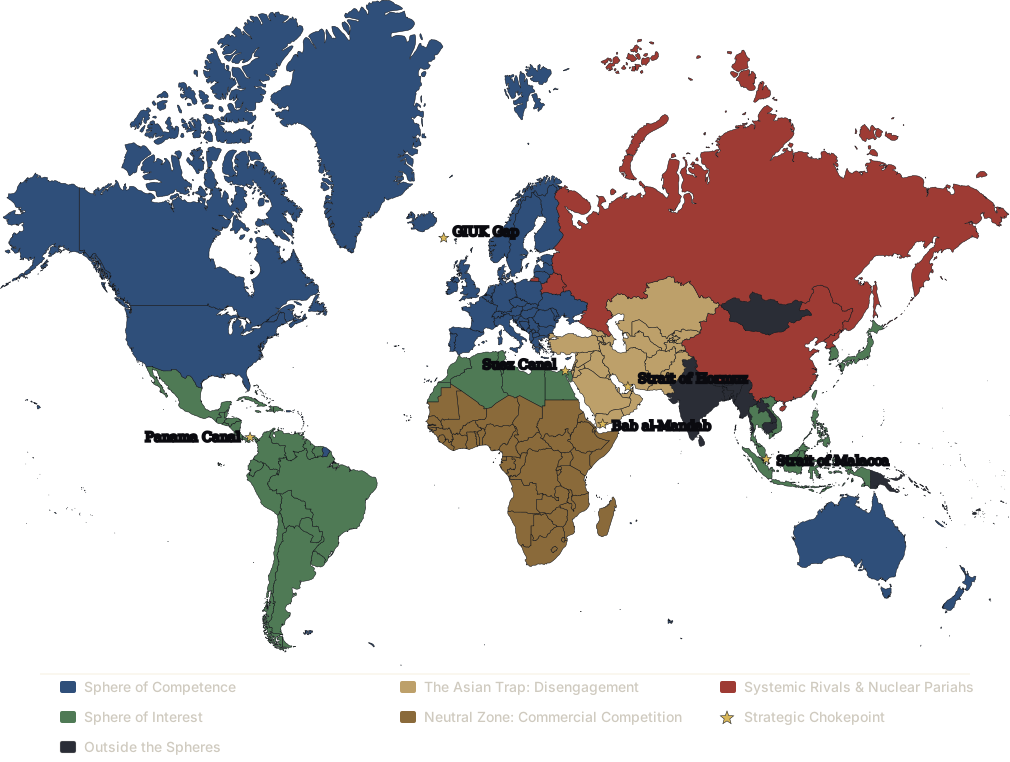
The map has three zones. The Sphere of Competence is the Federation itself, where the doctrine is not alliance but indivisibility: an armored incursion into the Baltics or a naval threat to Australia is an attack on the whole, answered by the whole, with a Military Schengen for federal forces, an integrated missile shield over the entire sky, and state-sponsored terrorism classified as an act of war. The sphere extends explicitly to Antarctica, where the Federation assumes the role of armed guardian of the Antarctic Treaty, enforcing a military exclusion zone against any rival base on the last continent. The Sphere of Interest covers Latin America and the southern Mediterranean under Graduated Hegemony: a security floor of Strategic Denial, no rival bases, no rival control of ports or networks, no strategic weapons, enforced up to kinetic intervention, and above that floor, integration strictly by merit through the rings. The third zone is the deliberate inversion called the Asian Trap: for decades the West policed Eurasian instability at colossal cost while China rode free on the stability we paid for. The blueprint ends the subsidy through calibrated disengagement from the Eurasian interior, leaving the chaos to press on those who aspire to regional hegemony, if Beijing wants empire, let it pay for imperial policing, while the West shifts to offshore balancing: no permanent boots in the swamp, but over-the-horizon strike capacity, and full protection maintained for Japan, South Korea, and the Pacific allies. The disengagement concerns the swamp, never the fortress.
The military instrument is unified: a federal army under single command, space and cyberspace as primary domains, and at the apex the Unified Nuclear Triad, the British, French, and American deterrents integrated into a single operational plan under the President's ultimate authority, so no adversary can ever again exploit ambiguity between Western capitals, modernized with priority to a new generation of ultra-quiet ballistic-missile submarines guaranteeing second-strike certainty. Beneath the nuclear roof, maritime hegemony built on a geographic fact: the West and its partners physically hold the gates of the world ocean while its continental rivals sit behind closed seas. Panama protected as a domestic asset; the GIUK gap and the opening Arctic wired with sensors under Canadian leadership of a Northern Shield; Suez secured through partnership with Egypt; Hormuz and Bab al-Mandab kept open by force against any actor who tests them. And Malacca, the jugular through which 80 percent of China's energy imports pass, governed by flexible denial: maximum deterrent pressure in peace, and in open war, if forward control becomes unsustainable, a distant blockade at the Indian Ocean approaches that strangles the same flows from safe range. In peace the fleet is the guardian of the global commons; in war it is the jailer.
The rivals are handled each by name. Russia is the revanchist pariah, a declining power compensating for internal failure by breaking the first taboo of the postwar order. The response is irreversible energy decoupling that physically dismantles the import infrastructure, a technology embargo that forces its armed forces into de-evolution, and a fortified eastern wall, while pricing in the Sino-Russian embrace as a trap that closes on Moscow first, since China seeks vassals, not allies. The door to the West is locked and barricaded, but not walled up: the key is the end of aggression, withdrawal from occupied territory, and verifiable westernization, because a Russia eventually reintegrated would be the ultimate counterweight to China. China itself is the systemic competitor, met on three levels: sincere cultural respect, explicit recognition of a civilization-state of five thousand years and abandonment of the arrogant project of converting it into a copy of the West; economic competition under Small Yard, High Fence, total decoupling in the few force-multiplier technologies and brutal reciprocity everywhere else, with Fourth Ring status forcing Beijing to trade in Solidus and thereby finance the system that contains it; and deterrence built on suffocation rather than soldiers. On Taiwan the doctrine shifts from strategic ambiguity to Porcupine Realism: every tool of self-defense for Taipei, but no automatic commitment of Western ground troops; what guarantees peace is Beijing's certain knowledge that aggression triggers the instant freezing of its Solidus reserves, exclusion from the payment system, and distant blockade of its energy lifelines, collapse within months without a single Western soldier on Chinese soil. The challenge has a name, the permanent Sputnik moment: the competition that forces the West to be the best version of itself. Theocracies are ringed by a cordon sanitaire, and organized crime is elevated to its true rank, a Shadow Empire of cartels warranting total war rather than police work.
Israel is a unique case: a hybrid power enjoying influence inside Western democracies comparable to a domestic actor, above all in the United States, while acting internationally as a fully sovereign state whose interests increasingly diverge from Western ones. The diagnosis is itemized: Chinese state companies acquiring critical infrastructure such as the port of Haifa while the West fought Beijing's rise; strategic ambiguity toward Russia while the West bled to isolate it; the drain on Western diplomatic capital from automatic cover for Israel's most aggressive regional policies; and an undeclared nuclear arsenal outside any Western chain of command. The doctrine ends the asymmetry with a binary, structured choice. Integration: entry into the Third Ring alongside Japan and South Korea, carrying the Federation's technological defense guarantee and the extension of its nuclear umbrella against the Iranian threat, in exchange for full strategic alignment, decoupling from China, conformity with international law, and, over time and under Western guarantee, the integration of its arsenal under a dual-key arrangement. Alienation: full freedom of unilateral action, as a Fourth Ring state, with the immediate end of military aid, diplomatic cover, and sensitive technology flows. A nation of nine million cannot be permitted to set the foreign policy of a billion-strong superpower. The domestic complement applies the general transparency machinery without exemption, lobbying for Israeli interests registers as foreign agency like any other, and the line is drawn carefully: Western Jewish citizens are an integral and valued part of the civic family, distinct from the State of Israel, a foreign government with its own interests, and citizenship is governed by a doctrine of Exclusive Loyalty that judges actions, never identities, whoever acts and whichever flag benefits.
Immigration returns here as a weapon: a campaign of cognitive plundering aimed at the top one percent of human capital inside rival states, the demoralized Russian missile engineer, the censored Chinese AI researcher, the secular Iranian physicist, recruited through a Strategic Visa offering assisted defection and accelerated citizenship, bound by a ten-year Non-Return Pact whose violation triggers automatic revocation and espionage liability. Every defection counts twice, a gain for the West and an irrecoverable loss for the rival, and regimes that know their best minds are being hunted must cage them, strangling their own innovation. It is the most elegant form of warfare: instead of bombing enemy laboratories, we empty them. Finally, the institutional order itself is repossessed rather than abandoned: an extraordinary assembly adopts a New Charter of Free Nations under which membership in the international community becomes a privilege conditional on verifiable democracy and law, demoting refusing autocracies to observers without vote or veto, rebuilding the Security Council around democratic powers, absorbing the WTO into the Ring System, and purging the technical agencies of the influence of regimes that conceal pandemics.
The closing doctrine gives the book its title. Pax Occidentalis rests not on treaties or goodwill but on a preponderance of power so visible and so ready that war becomes irrational for anyone else, exercised at a distance: command of the chokepoints, the financial rails, and the technological frontier, the remote control of the global economy, with the patience to let rigid, demographically doomed autocracies break against their own contradictions. The real victory lies in outlasting them. And the fortress is not the destination: it is built to secure the base from which Western civilization, its values intact, leads the human expansion into space.
X. The Resistance
None of this is around the corner. Every reform will collide with the entrenched interests that profit from the current disorder, and, more painfully, with the West's own citizens, because the project refuses the dogmas of every faction and therefore offends each at its most sensitive point.
The deepest objection is the sovereignty paradox: the people most alarmed by Western decline are often the most devoted to the nation-state, sympathetic to every page of the diagnosis and allergic to the prescription. The answer offered is not that nations matter less than nationalists believe, but that federation is now the only mechanism that can preserve them. The nations of the West built cathedrals, composed symphonies, and conquered oceans long before any federation was conceived, and under the blueprint they remain the primary communities in which their citizens live, work, love, and die, their schools, courts, and languages protected, their right of secession written into the treaty itself. What they pool are powers already lost in practice: no nation can deter a continental superpower, anchor a currency, or rebuild a chip industry alone. The choice is between sovereignty as a flag and sovereignty as a fact.
The second objection is feasibility, and there is no flattering the reader: the blueprint maps the destination and names the missing ingredient for what it is, not a technical variable but collective will, the ultimate test of a generation. Someone must first draw the fortress before anyone can decide to lay its stones. The third objection is risk, above all monetary, and the reply is the design itself, the announced conversion, the constitutional constraints, the reserve floor, plus a standing invitation: every figure in the blueprint, the cost of the family pact, the yield of the wealth tax, the fertility estimate, is published precisely so that it can be attacked with better numbers rather than with adjectives.
XI. The Choice
It all ends not with a forecast but with a fork.
One path is called Irrelevance, and described without contempt, because it is the easy one: continue consuming the capital of the fathers, manage the decline politely, become the open-air museum, rich in monuments and empty of power, visited by tourists and governed, in everything that matters, by others. The sweet euthanasia of a civilization that has stopped believing in itself.
The other is called Legacy, and priced honestly: the breaking of established patterns, sacrifice in the present for power in the future, resting on one recognition, that freedom is not a natural condition but a historical anomaly defended daily, and one image, the West as temporary custodian of a flame lit in Athens, protected in Rome, fueled in London and Paris, raised to new heights in Washington, and now entrusted to a generation that must decide whether to carry it. The Federation, in the end, is justified not as an empire but as armor: in a world of wolves, the only way to protect the lamb of freedom is for it to wear the armor of the lion.
No guarantee of success is asked, because history gives none. To the prophets of decline: you described the fall of the West as inevitable; it was only a choice, and we now choose differently. To the rivals watching for weakness: do not mistake our debate for division, or our tolerance for timidity. And to the citizens of the West: do not wait for a savior. The union begins when each of us stops being a victim of history and becomes a protagonist.
The night of decline may seem long, but dawn is a decision.
The West is not finished. The West has just begun.
· · ·